
Ask a self-storage revenue manager whether a store is priced above or below its market, and the honest answer is often “it depends which unit”. A store can be the cheapest 5x5 in town and the most expensive 10x20. Averages across the store hide that, and averages across competitors hide who is doing the undercutting.
Storage 360 answers the question at the level where prices are actually set: one store, one unit type, against the competitors in the same market. This post explains the index, the four views built on it, and how it feeds the street-rate AI.
Like for like, or not at all
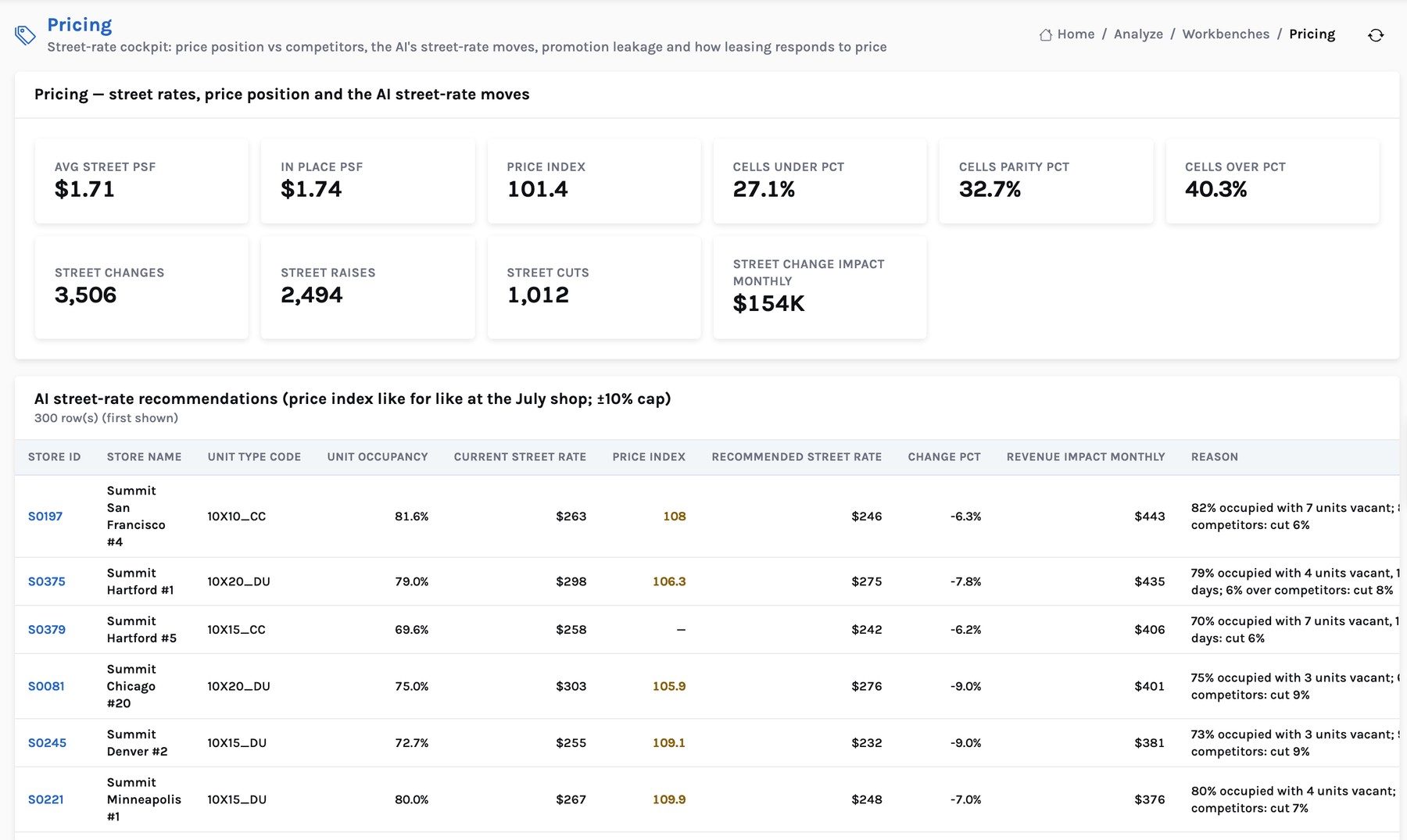
The price index compares our street rate with the average competitor street rate for the same unit type in the same market, from the latest rate shop. 100 means we match the competitor average. 105 means we are 5% dearer. 95 means 5% cheaper.
Comparing like for like matters more than any modelling choice. A 10x10 climate-controlled unit and a 10x10 drive-up are different products at different prices. Blending them produces an index that moves when the unit mix changes, not when prices do.
Cell indices roll up to stores, markets and the portfolio, weighted by units. In the demo the portfolio index is 101.4. Of 5,379 store × unit-type cells, 27% are more than 3% under the market, 33% are at parity within ±3%, and 40% are more than 3% over.
Four views built on one index
The Competition workbench turns the index into four answers a revenue team needs every quarter.
1. Our index against each operator
The same calculation, run against one competitor at a time: our street rate divided by theirs, for the unit types and markets where we both operate, with the change in index points since last quarter and last year. It tells you whether a gap is with the whole market or with one operator.
Invented numbers and generic operator names, for illustration only. Vertical line = 100 (parity). Bars start at 0; scale 0–120.
The illustrative pattern above is a common one. Against the national REITs the store looks fairly priced, even cheap. Against independents it is 12% dearer — and independents are often where the price-sensitive customer goes.
2. The gap to the cheapest store
The average competitor is a useful benchmark. The cheapest competitor is a useful warning. For each market, Storage 360 shows our unit-weighted street rate against the cheapest competitor rate for each unit type, the percentage gap, and the share of our cells priced above that floor. A store can sit at parity with the average and still be 20% above the price a shopper will find first.
3. Fair share
Price is half the picture; demand is the other. Fair share compares our share of the market's units with our estimated share of its move-ins over the last twelve months. A penetration index above 100 means we win more than our share of renters; below 100, fewer. A market where we are over-priced and under-penetrating is the clearest case for a cut. One where we are over-priced and still winning share is a case for leaving well alone.
4. Rate-move alerts
When an operator moves its street rates 5% or more in a quarter beyond what the rest of the market did, Storage 360 raises a competitor rate-move alert on that operator and that market, with our current index there. A 9% move is high severity. The demo has 24 such alerts open. Measuring the move against the market filters out seasonal shifts that every operator makes at once.
Where the index meets the market
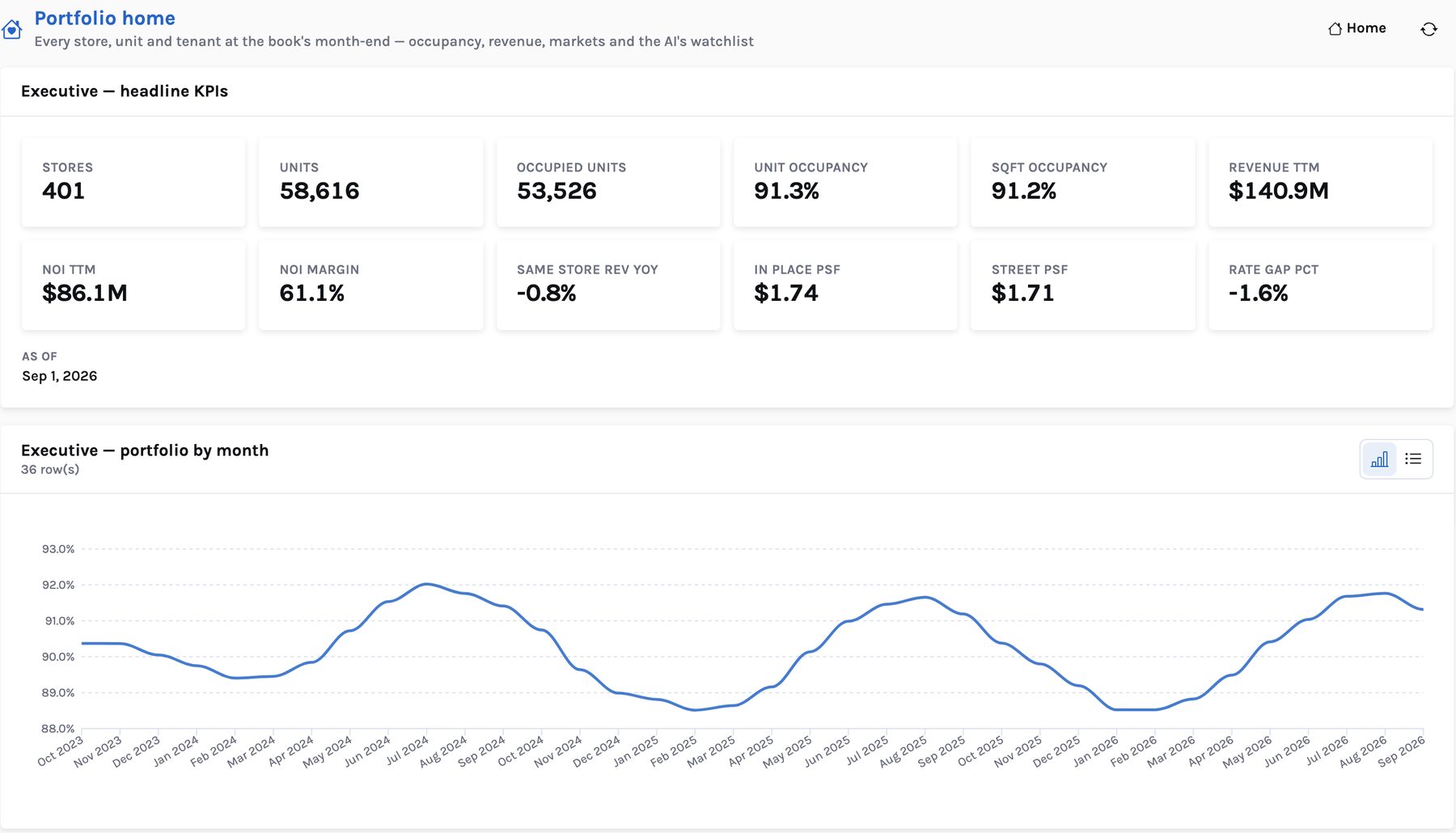
Market 360 pages put the index beside the demand side: population, growth, supply per person, new supply, and our share of stores. On the portfolio home, the markets table shows each market's own and competitor store counts, our street rate per square foot against the competitor average, and our store share.
Competitors are companies, too
Several of the largest self-storage operators are public companies. In Storage 360 each operator links to its entry in the InsightPulse public company graph, so the Operator 360 shows the company profile and recent events beside that operator's street rates and alerts. A rate cut reads differently when you can see the same company has just announced an acquisition in that market.
The index is only as good as the rate shop behind it. Storage 360 reads whatever rate-shop feed you already license, as a table in your lakehouse, and records which quarter's shop each index comes from. In the demo, competitor rates are synthetic and illustrative.
The question it answers
“Are we cheap or expensive here?” should have a one-number answer for every store and unit type, and a short list of who we are cheap or expensive against. With that, the street-rate conversation stops being about opinions and starts being about cells.
See the Competition and Pricing workbenches on the Storage 360 page, or read how the index guards the AI's moves in explainable street-rate management.
Storage 360: AI-native revenue and operations intelligence for self-storage
The AI layer, the pricing and rent-increase logic, the lakehouse architecture and the 90-day pilot, in one PDF.