
Every self-storage operator knows the trade. Raise rents on existing tenants and revenue goes up next month. Raise them too far, too often, on the wrong tenants, and some of those tenants leave — and an empty unit earns nothing until it is let again at street rate, usually with a discount.
Most operators manage this trade with a tenure rule: everyone past twelve months gets a letter. Storage 360 replaces the rule with a recommendation per lease. This post covers how the copilot decides, the fairness caps it applies, the drivers of move-out risk, and the simulator that prices a whole policy.
What the copilot found
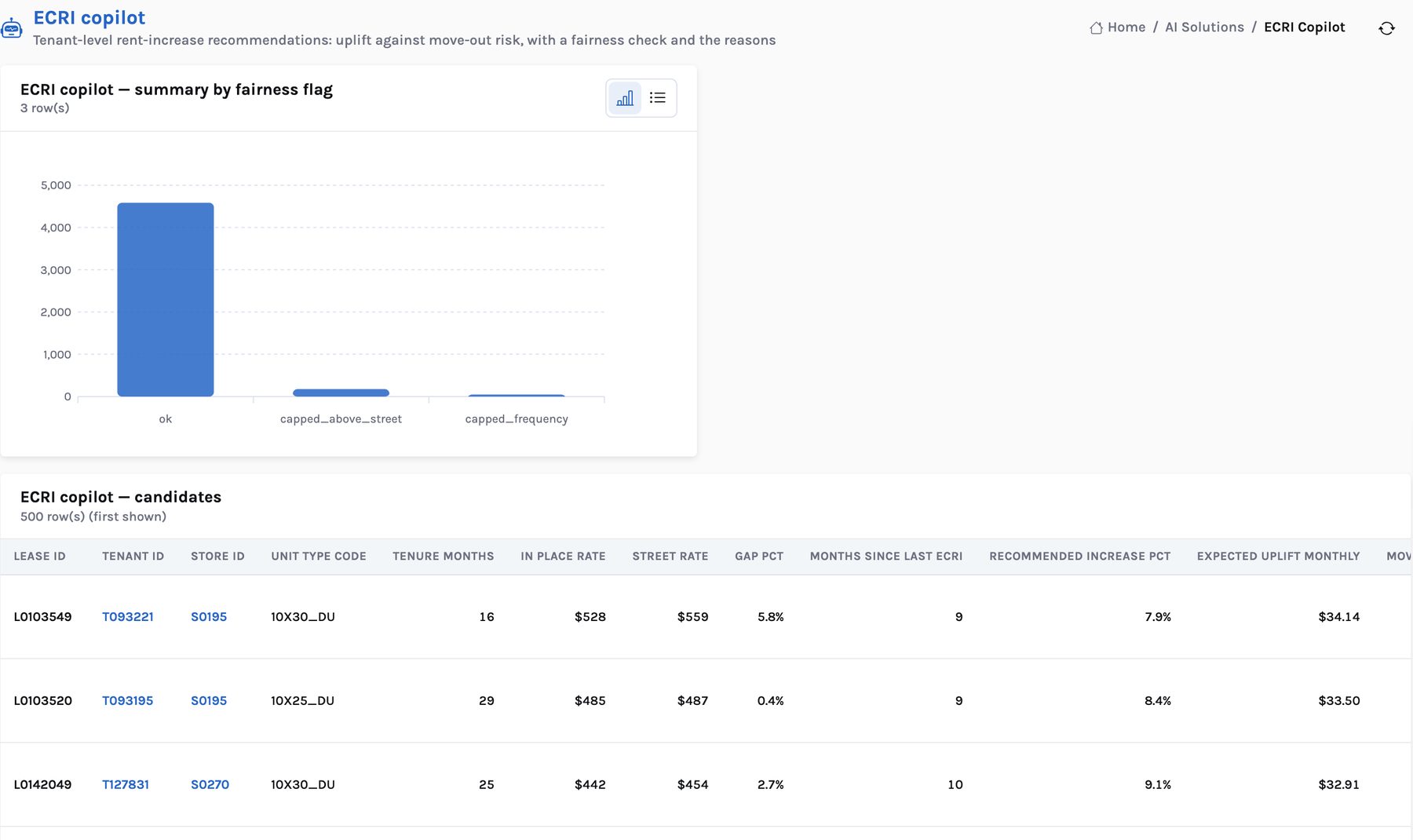
In the demo portfolio 4,807 leases are eligible for an increase today. Priced lease by lease, and after subtracting the tenants expected to leave, they are worth $626K a year. Before anyone sees the list, 224 of those increases are capped or flagged by fairness rules.
Eligibility is deliberately narrow: at least six months of tenure, at least nine months since the last increase, and no open delinquency. A tenant who owes money gets a collections conversation, not a rent increase.
How one lease is priced
The recommended increase starts from the gap between what the tenant pays and today's street rate for the same unit type. A tenant paying well below street has room; a tenant already above street has little. Long tenure adds a little, because tenants of two years or more are the stickiest. A high move-out risk score takes the recommendation down. The result is bounded between 3% and 15%.
Then the copilot does the part a tenure rule never does: it estimates the chance this tenant leaves because of this increase, and subtracts it. Expected uplift is the increase kept by tenants who stay, minus the turnover cost of those who go. Every recommendation carries a one-line explanation — what the tenant pays, the street rate, tenure, months since the last increase, and the expected uplift after the move-out risk.
Fairness caps are rules, not judgement calls
An increase can be profitable and still be wrong. The copilot applies three rules before the list leaves the system:
- Already above street. A tenant paying more than 30% above today's street rate is held to a 3% increase.
- Cumulative increases. Where increases already total more than 25% in 24 months, the next one is capped at 5%.
- Frequency. Three or more increases in under three years of tenure is flagged for a person to review.
These are written as rules, with the flag stored on each lease, for two reasons. A district manager can see exactly why a tenant got a smaller increase. And when a customer complains, the business can show the policy it applied, not a model's opinion.
What drives move-out risk
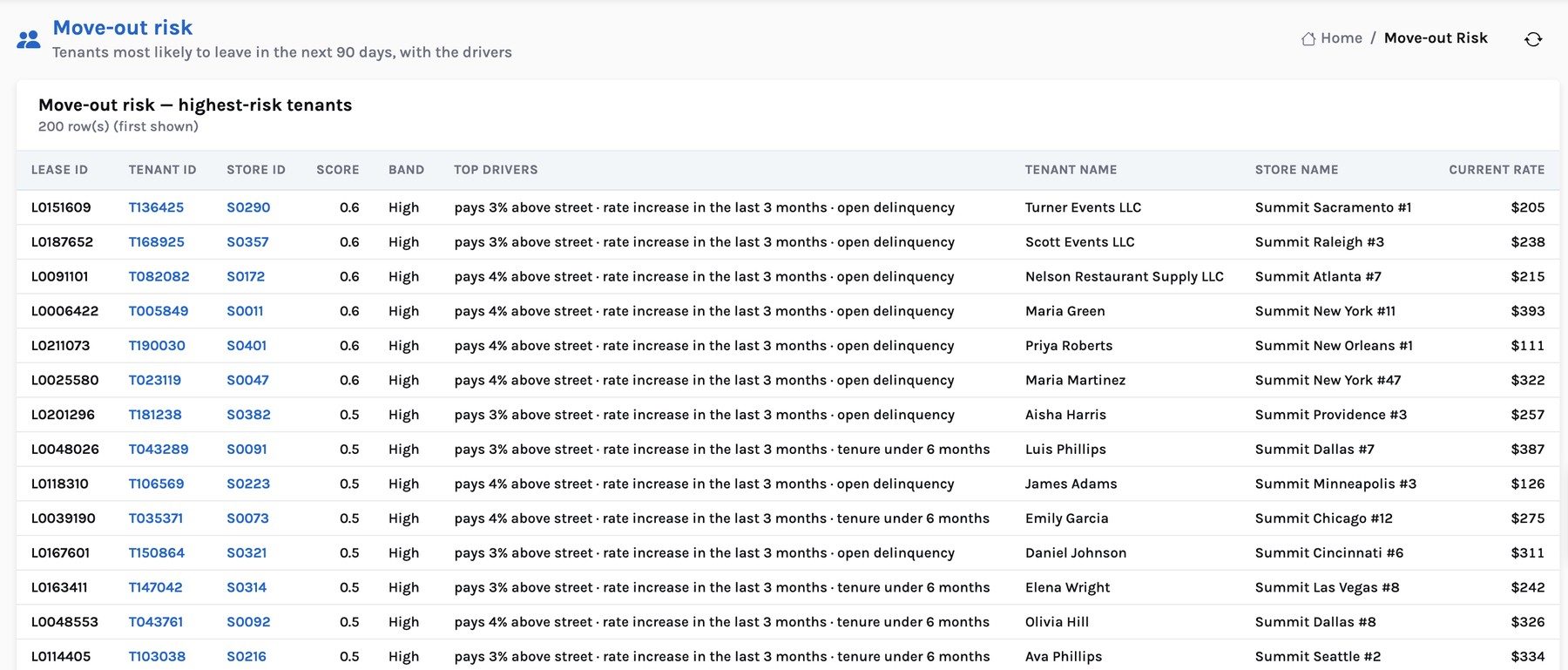
Move-out risk is scored for every active lease, and the 868 tenants most likely to leave in the next 90 days raise an alert. Each score comes with its drivers, in words:
The pattern in the alerts is consistent. The highest-risk tenants usually combine all three of the strongest drivers: they pay 3–4% above street, they had an increase in the last three months, and they carry an open balance. That is a tenant who has just been given a reason to shop around.
The simulator: price the policy, not just the lease
A revenue leader does not approve 4,807 recommendations one by one. She approves a policy: a maximum increase, a minimum tenure, a limit on how far above street a tenant can be pushed. The simulator shows what a policy earns and what it costs, before anything is sent.
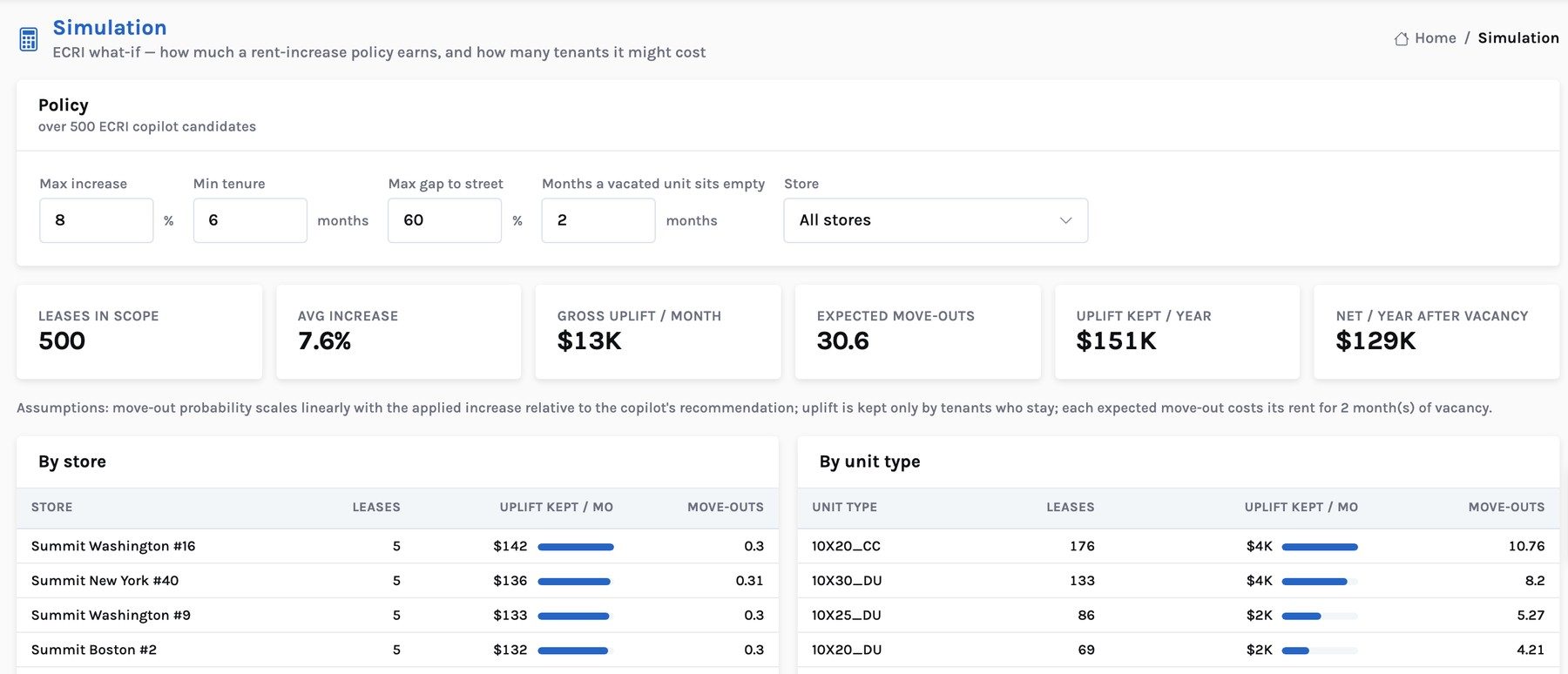
Simulator assumptions: move-out probability scales with the applied increase relative to the copilot's recommendation; uplift is kept only by tenants who stay; each move-out costs 2 months of that unit's rent.
At an 8% cap on the top 500 candidates, the average increase is 7.6%. The policy keeps $151K a year of uplift from tenants who stay, and is expected to cost 30.6 move-outs. At two months of vacancy each, those move-outs cost about $22K, leaving $129K net. Raise the cap and the gross number rises; so do the move-outs. Run it again at a different cap and compare the net; the breakdown by store and unit type shows where the uplift comes from.
The copilot and simulator produce a list and a number. Letters and rate changes are still made in your PMS, by your team. Storage 360 makes the decision explicit; it does not send anything to tenants.
Why this matters
Rent increases and street rates together are worth about $2.47M a year in the demo portfolio, roughly 1.8% of revenue. The rent-increase share is the more fragile of the two, because the cost — a tenant who leaves — arrives a month later and is easy to miss. Pricing each lease against its own risk, with rules a customer would recognise as fair, is how that share is kept.
More on the Storage 360 page. For the street-rate side, see explainable street-rate management.
Storage 360: AI-native revenue and operations intelligence for self-storage
The AI layer, the pricing and rent-increase logic, the lakehouse architecture and the 90-day pilot, in one PDF.